Showing posts with label Animation. Show all posts

Friday, 11 November 2016

Pixilation

Pixilation
This a stop motion animation technique using real people, this is one of the most popular techniques in stop motion but also the easiest because you don't have to create models if you don't have any artistic skills which many people unfortunately do not have, using people can create an alternative to creating well drawn sketches or well detailed model characters. This can also, save time and your sanity because of the levels of stress that model animating can cause (you have been warned), another positive to pixilation is the accuracy that you can maintain throughout the animation because you have complete control over your physical shape and appearance.

The way this technique works is you take a still image of the person you are filming, you then slightly move the part of the body you wish, just slightly,  and take another still image then continue to repeat this process.

Some examples:


Tuesday, 8 November 2016

Time-lapse

Time-lapse is a form of animation but is commonly mistaken for photography as it is not a model or a drawing but photos, this is a common misconception.

Time-lapse is a way to capture a long process that could take days, weeks or months even, and refines it down to a few seconds in a clip. This gives the ability to capture beautiful scenes like a sunset or a flower blooming in spring time and give the ability to watch it without having to stare for hours at a still object.

It does this by capturing still images from the same position every few seconds and then is played back at a steady 30 frames per second,  For example, an image of a scene may be captured once every second, then played back at 30 frames per second; the result is an apparent 30 times speed increase. 

Some examples of Time-lapse from Mr Casey Neistat:


Wednesday, 19 October 2016

Cutout Animation

Cutout Animation
This is an animation technique for creating a stop motion animation from flat paper cut outs of a character, a prop and the background. Not all have to be cut from paper, they are sometimes cut from: card, stiff fabric or even photographs. they are done like any stop motion animation, by taking a series of still images of slightly moved objects and then is played back as a certain frame per second to give the illusion it is moving, this is the exact way cut out animation is created, by moving cut out models to create a series of still images that appear to make the object move.

By today cut out animations such as South Park are mostly done on computers like any other animation in the modern age due to the ability to be more efficient in creating a full show on the computer rather than cutting out separate characters for every scene. This process is done by scanning images being used rather than a physical version of the cut out. Going back to South Park, the Pilot episode was actual physical cut outs of the characters before the creators (Trey Parker, Matt Stone) decided it would be more efficient to create the show on a computer.

This is the first ever episode (pilot) of south park in the best quality i could find on youtube.


My own Cut out animation:


Tuesday, 4 October 2016

Cellulose Plastic (Cel) Animations

Cellulose Plastic (Cel) Animations

Cellulose Plastic animations are some of the first animation techniques for had drawn cartoons in the modern age from the start of the 1920s.

The process is made up from a hand drawing on paper that is then traced onto a slide of cellulose plastic. The initial trace of the drawing is simply the dark black outline of the drawing, the sheet is then turned over and painted on the other side inside the lines of the trace.

The drawings are then placed on a sort of filing system which is used to keep all the images aligned so they can then be photographed, the sheets of Cel' plastic has holes like filing paper or plastic wallets that are inserted into the the file, this secures the images accurately. This sets the wheels in motion for the animation to begin. An example of this technique is shown below.


This 1930's video shows in early 1900's style the exact procedure that Walt Disney had to go through to create his first masterpiece 'Snow White and the seven dwarfs.'


Snow White and the Seven Dwarfs was Walt Disney's first film to be received by critics back in 1937, it was a huge success being one of the first cartoon full length movie, the movie was made by using cellulose plastic animation. By the time the finish was completed almost years after Walt Disney made his dream become a reality over 250'000 cellulose sheets had been produced by women is a printing office. The budget for this film was: $1,488,423. The film came out of the box office with a staggering: $418.2 million. 

The Quality of the animation from 'Steamboat Willie' to 'Snow White and the seven Dwarfs.' is obviously increased, not just because of the new addition of colour in the cartoon which creates a brand new dynamic theatre experience, but it is much smoother than the first cel animation Disney created, the reason for this is because more sheets where animated in one clip meaning there are almost 3 sheets for every 1 sheet in steamboat willie making the cartoon characters look like they are actually moving not a jagged 'laggy' movement.


Move on into the 1940s and and a young company is emerging, 'Hanna-Barbera' this company is responsible for a massive part of my own childhood, this company created the Cartoon shorts 'Tom and Jerry' a slapstick comedy cartoon for children about a devious mouse (Jerry) and a deranged cat (Tom) who will stop at nothing to catch the mouse, this cartoon was in my opinion the greatest cartoon series in history, but, like i said its my opinion. the difference between disneys cartoons and now Hanna-Barbera' is the speed and tone it has compared to its predecessor. Tom and Jerry is very slapstick and in some cases contained scenes of violence against two characters. This put a contrast between the two animators as Disney tried to keep his animations as child friendly as possible by today's standards, however back in the 40's not a single person would have an issue with tom and jerrys violence against each other, even though it is barely even violence at all because neither character ever actually got hurt, however, it would be difficult to air a show such as this to a new audience, it just wouldn't fit with the genre that parents expect unfortunately. never the less these cartoons showed that a children's cartoon can contain more than princesses and love story's, it can give you a real comical night of entertainment which that era was sorely missing.

A clip from Tom and Jerrys First televsion aired episode: 


However the animation in snow white and the seven dwarfs is an artifact by today's standards, cartoons today are made in bulk, shows like The Simpsons, Family Guy to name a few. Today cartoons are created on the computer meaning they are much faster to create but that doesn't mean the main animation technique is gone, the cartoon is still drawn in separate shots they are just edited using a computer once they are all drawn, shows like family guy (right) show that animation has the ability to be more than a children's form of entertainment.

'The success of 'The Simpsons' really opened doors. It showed that if you were working in animation you didn't necessarily have to be working in kids' television.' this is a quote from Family guys Creator Seth Macfarlane.

More quotes from him can be found here along with many other celeb quotes:


Wednesday, 28 September 2016

Old Animations

Old Animations

Animators have achieved a hell of a lot in the past 100 years, from still images moving in a spinning wheel to fully moving motion capture in films today.

This animation is called 'Le Voyage Dans la Lun' this roughly translates to 'A trip to the moon'
This animation was created in 1902 by a french film maker by the name   
of Georges Méliès. 
A Trip to the Moon
Voyage dans la lune title card.png
Title card
Directed byGeorges Méliès
Produced byGeorges Méliès
Written byGeorges Méliès
Based onFrom the Earth to the Moon and Around the Moon
by Jules Verne (see alsoInspirations section below)
Starring
  • Georges Méliès
  • Bleuette Bernon
  • François Lallement
  • Henri Delannoy
Cinematography
  • Théophile Michault
  • Lucien Tainguy
Production
company
Release dates
  • 1 September 1902(France)[1]
Running time
  • 260 meters/845 feet[2]
  • 18 minutes (12 frame/s)[3]
  • 16 minutes (14 frame/s)[3]
  • 9 minutes (24 frame/s)[3]
CountryFrance
LanguageSilent
Budget₣10,000
This is the final films statistics and cast. taken from Wikipedia.

Tuesday, 27 September 2016

Old Animation Tools and Techniques

Old Animation Tools and Techniques

Phenakistoscope (1831)


This is a Phenakistoscope.
The Phenakistoscope was an early animation device. It was invented in 1831 by a Belgian man by the name of 'Joseph Plateau' and Austrian man 'Simon von Stampfer.' It consists of a disk with a series of images, drawn on radii evenly spaced around the centre of the disk. Slots are cut out of the disk on the same radii as the drawings, but at a different distance from the centre. The device would be placed in front of a mirror and spun. As the phenakistoscope spins, a viewer looks through the slots at the reflection of the drawings, are momentarily visible when a slot passes by the viewer's eye. This created the illusion of animation.


Zoetrope (1834)

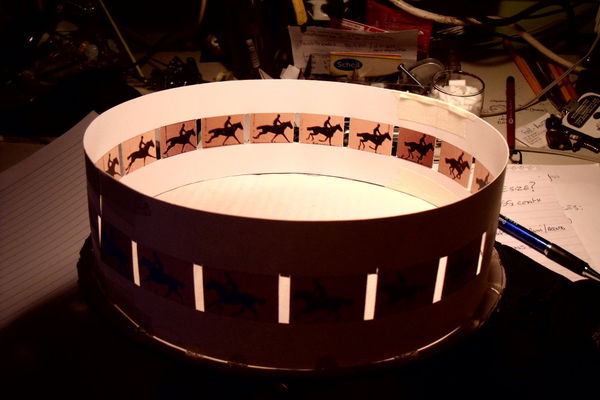
Image result for ZoetropeThe zoetrope concept was suggested in 1834 by William George Horner, and from the 1860s marketed as the zoetrope. It operates on the same principle as the phenakistoscope. It was a cylindrical spinning device with several frames of animation printed on a paper strip placed around the interior circumference. The observer looks through vertical slits around the sides to view the moving images on the opposite side as the cylinder spins. 
As it spins, the material between the viewing slits moves in the opposite direction of the images on the other side and in doing so serves as a rudimentary shutter. The zoetrope had several advantages over the basic phenakistoscope. It did not require the use of a mirror to view the illusion, and because of its cylindrical shape it could be viewed by several people at once.
In ancient China, people used a device that one 20th century historian categorized as "a variety of zoetrope."It had a series of translucent paper or mica panels and was operated by being hung over a lamp so that vanes at the top would cause it to rotate as heated air rose from the lamp. It has been claimed that this rotation, if it reached the ideal speed, caused the same illusion of animation as the later zoetrope, but because there was no shutter (the slits in a zoetrope) or other provision for intermittence, the effect was in fact simply a series of horizontally drifting figures, with no true animation


Wednesday, 21 September 2016

Persistence of Vision

What is Persistence of Vision?

Persistence of vision is when a sequence of still images each with very slight successive changes is played back, the brain tends to fill in the gaps between each image, and sees the sequence as a continuous movement rather than as a series of still images. This is the method used in animation and video to give the illusion of movement. Persistence of Vision works with images between 8 images or frames per second through to 30 images or frames per second.