Old Animation Tools and Techniques
Phenakistoscope (1831)

The Phenakistoscope was an early animation device. It was invented in 1831 by a Belgian man by the name of 'Joseph Plateau' and Austrian man 'Simon von Stampfer.' It consists of a disk with a series of images, drawn on radii evenly spaced around the centre of the disk. Slots are cut out of the disk on the same radii as the drawings, but at a different distance from the centre. The device would be placed in front of a mirror and spun. As the phenakistoscope spins, a viewer looks through the slots at the reflection of the drawings, are momentarily visible when a slot passes by the viewer's eye. This created the illusion of animation.
Zoetrope (1834)
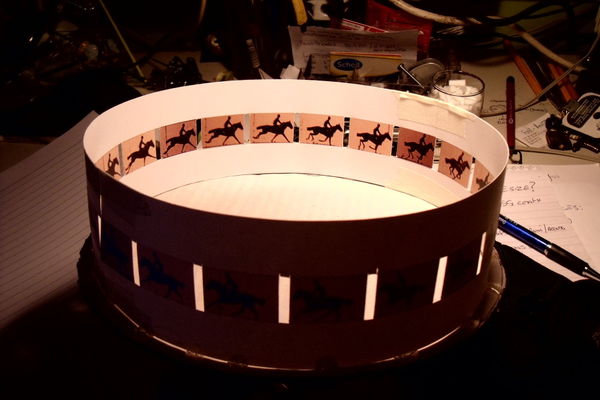 The zoetrope concept was suggested in 1834 by William George Horner, and from the 1860s marketed as the zoetrope. It operates on the same principle as the phenakistoscope. It was a cylindrical spinning device with several frames of animation printed on a paper strip placed around the interior circumference. The observer looks through vertical slits around the sides to view the moving images on the opposite side as the cylinder spins.
 As it spins, the material between the viewing slits moves in the opposite direction of the images on the other side and in doing so serves as a rudimentary shutter. The zoetrope had several advantages over the basic phenakistoscope. It did not require the use of a mirror to view the illusion, and because of its cylindrical shape it could be viewed by several people at once.
In ancient China, people used a device that one 20th century historian categorized as "a variety of zoetrope."It had a series of translucent paper or mica panels and was operated by being hung over a lamp so that vanes at the top would cause it to rotate as heated air rose from the lamp. It has been claimed that this rotation, if it reached the ideal speed, caused the same illusion of animation as the later zoetrope, but because there was no shutter (the slits in a zoetrope) or other provision for intermittence, the effect was in fact simply a series of horizontally drifting figures, with no true animation

No comments:
Post a Comment